Neural agent world
A downloadable tool for Windows
Hello.
Together with the LLM Claude, I experimented with an old idea of mine based on evolutionary selection. What came out of it is what I'm presenting to you today.
To the best of my knowledge, I minimized "intelligent design" by allowing simple neural networks to evolve under the pressure of natural selection. Depending on the settings in the configuration file, the networks can either grow more complex over time or degenerate in order to survive.
If you're interested, feel free to ask questions. I don't have the spare time to write detailed documentation for something that nobody may end up playing.
The concept is mine; Claude wrote the code.
Neural Agent World
- Neuroevolution sandbox: agents grow their own neural networks, generation after generation.
- No goals, no score. Just 200 brains fighting over food for ten thousand generations.
---
Neural Agent World is a neuroevolution sandbox. Two hundred agents live on a tile map, eat,
fight, heal each other, lay eggs and starve. Each one is driven by its own neural network —
and those networks are not designed by anyone. They mutate. Layers appear, neurons multiply,
memory cells grow in. Whatever survives long enough gets to reproduce.
There is no win condition. You are here to watch something get slightly less stupid over a
few thousand generations, and to dig into why.
---
Full description
Every generation, agents spawn into a 250x250 tile world with food, stone piles and boulders.
They have 90 senses — hunger, health, what they are carrying, the eight tiles around them,
the nearest other agent, shouts, footsteps, the smell of food — and 14 actions. Between the
two sits a feedforward network that started life as a random scribble.
At the end of the cycle the best performers are selected, mutated and put back in. Mutations
are structural, not just numeric: a network can gain a neuron, gain a whole layer, or grow a
memory cell that carries state from one tick to the next. Over thousands of generations,
architectures drift, split into lineages, and occasionally something genuinely new shows up.
### Watching, not playing
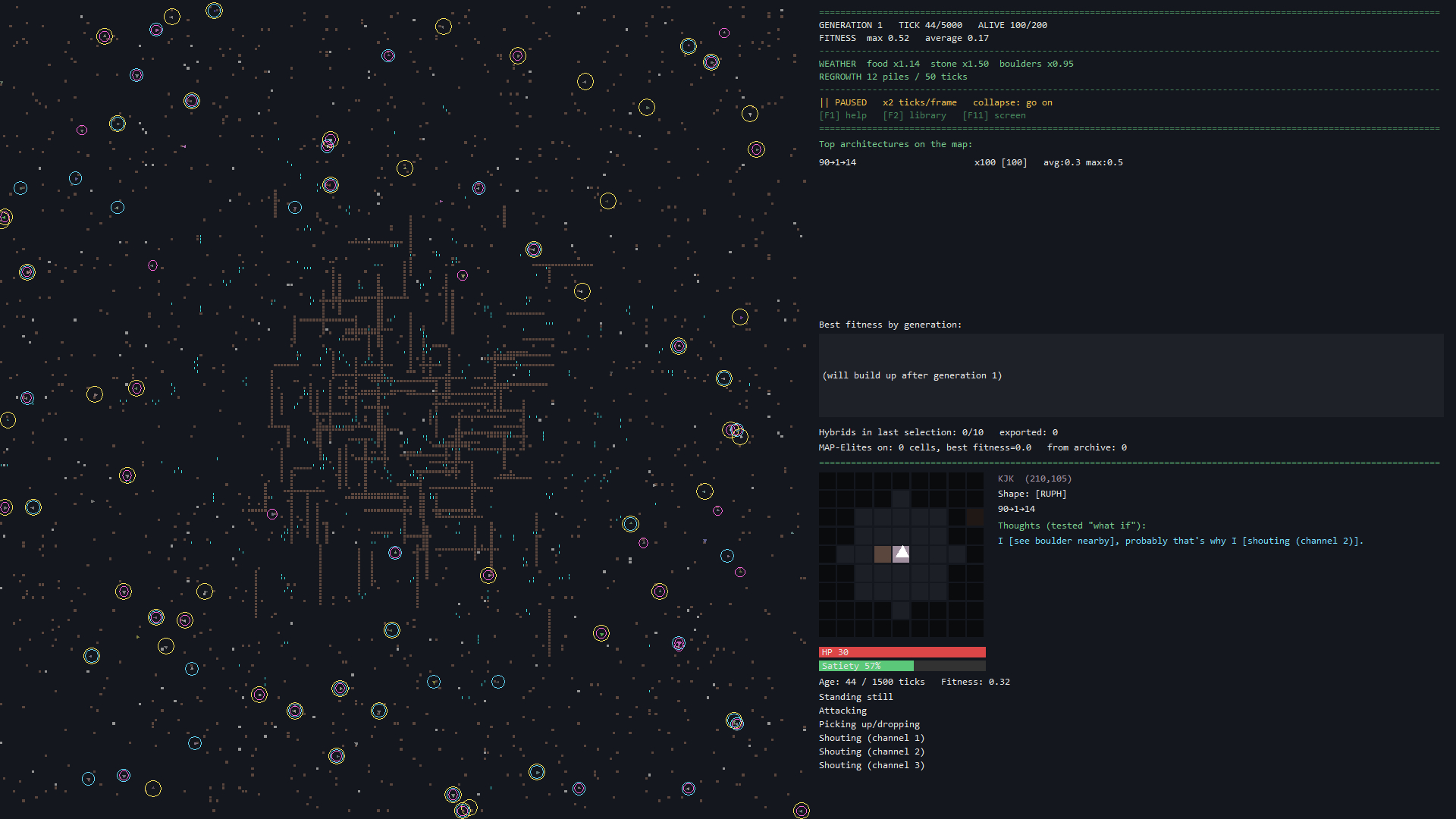
The right-hand panel is the actual interface. It shows live fitness, architecture spread,
lineage counts, the weather cycle, cause-of-death breakdowns and a magnifier that follows one
agent and prints what it is currently sensing and deciding. Click any agent to follow it.
Turbo mode drops rendering entirely and runs the simulation as fast as your CPU allows — this
is how you get to generation 10,000 in an evening.
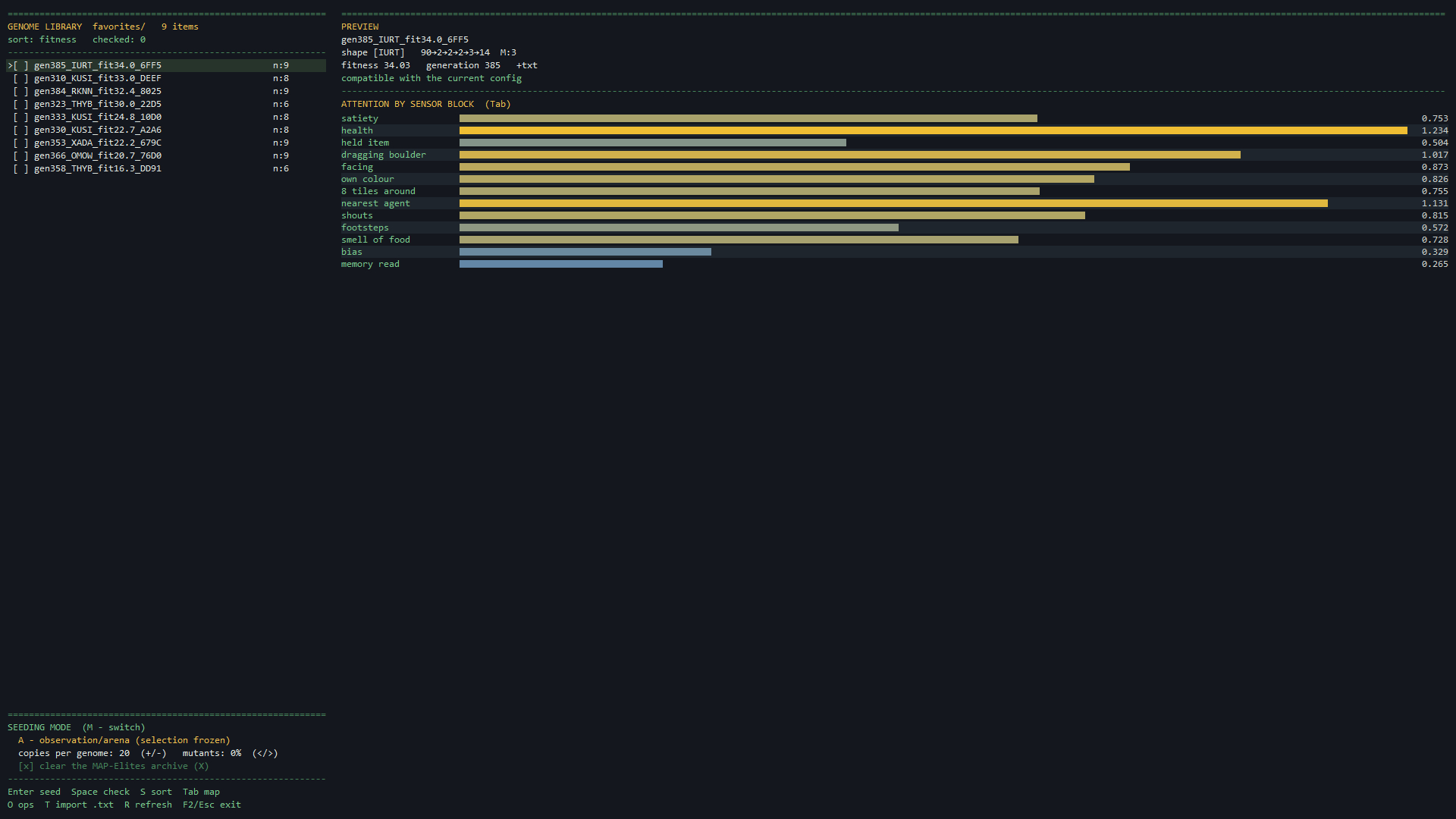
### The genome library
Any brain you like can be exported to disk, both as a binary genome and as a fully readable
text dump of every weight. The built-in library browser (F2) lets you:
- **Seed a fresh run** from a genome you saved a week ago
- **Inject** an old champion into a running experiment and watch whether its lineage survives
- **Stage an arena**: pick three genomes, spawn clones of each, freeze selection entirely and
see who out-competes whom
- Inspect a brain as a heat map — either raw first-layer weights, or attention grouped by
sensor block, so you can tell at a glance whether a creature is effectively blind
- Blind a genome on purpose, cut its memory, add noise, and save the result as a new specimen
### Everything is a file
The whole simulation is one C++ file talking to raw Win32 — no engine, no runtime, no
installer, ~3 MB. Every run appends to `stats.csv`: 60+ columns per generation, including
diagnostic flags marking which experimental settings were active, so runs never silently
blend together. Some 120 parameters live in `config.ini` and are meant to be edited.
### This is a research toy, and it shows
It was built to chase one specific question: *why do complex, fit mutants fail to fixate?*
Why does a bigger brain that clearly does better keep failing to take over the population?
That question is not solved. The instrumentation exists because someone needed the numbers.
If you want a game, this is not one. If you want to leave something running on a second
monitor and occasionally go "huh", you may like it a lot.
---
## Controls
| Key | Action |
|---|---|
| Space | Pause |
| Right arrow | Single tick (step mode) |
| + / − | Speed (ticks per frame) |
| T | Turbo (no rendering, uncaps FPS) |
| I | Infinite observation mode |
| C | Toggle early cycle end on diversity collapse |
| Click | Select an agent for the magnifier |
| E | Export the selected agent's genome to `favorites/` |
| F2 | Genome library — seed, inject, arena, heat maps |
| A | Leave the arena (unfreeze selection) |
| F11 / Alt+Enter | Fullscreen |
| F1 | Help |
| Ctrl+S | Save manually |
Download
Click download now to get access to the following files:
Leave a comment
Log in with itch.io to leave a comment.